How to Choose Seasonal Graphics You Can Wear After the Holiday
A festive piece can earn a place in your everyday wardrobe. Start with the pattern, then consider the words, colours and outfits you will actually wear.
You spot a sweater that feels perfect for a holiday dinner. The colour is cheerful, the graphic makes you smile, and you can already picture the photo. Then comes the less exciting question: will you still reach for it once the decorations come down?
If you want a seasonal graphic to last beyond one occasion, choose a design that connects with the season and your personal style. A snowflake, a geometric knit or a simple star can suggest a mood without naming a particular celebration. A large holiday greeting makes a much more specific statement.
Both can be good choices. The difference is the job you want the piece to do. A deliberately over-the-top party sweater can be exactly right for an annual event. A sweater you expect to wear every week needs to work with more of your life. Here is how to tell the difference before you buy.
Imagine wearing it after the holiday
Ask yourself: would I wear this on an ordinary day after the holiday has passed?
For winter holiday shopping, that might mean a normal afternoon in February. Imagine going for coffee, meeting a friend or working from home. Keep the weather appropriate to where you live: the point is to remove the celebration from the picture, not to make a heavy sweater work in warm weather.
Try to picture the whole outfit, rather than the item alone. If you can immediately imagine the sweater with your usual jeans and coat, it has a plausible second life. If the only outfit you can see includes a party hat and a holiday backdrop, you may be choosing an occasion piece. That is useful information, not a reason to feel bad about liking it.
Replace “Could someone wear this later?” with “Would I actually choose this later?” Your own habits are a better guide than an imagined rule about what is acceptable.
Read the graphic before you judge the colour
Colour creates a mood, but words and recognisable characters often explain the occasion. A plain red sweater can fit many outfits. A grey sweater covered in Christmas greetings still carries a clear holiday message.
Look at the design in this order: the words, the main motif, then the overall combination. This helps you avoid assuming that every bright knit is a novelty piece or that every neutral one is versatile.
Motifs that leave more room for everyday styling
Snowflakes, small stars, diamonds, stripes and geometric bands can sit comfortably in a cold-weather wardrobe. Their versatility depends on the whole design: a few snowflakes on a simple knit read differently from snowflakes surrounding a large Santa illustration and a holiday slogan.
The same idea applies beyond winter. A skull on a T-shirt may connect with Halloween, but it can also belong in someone's usual graphic-tee wardrobe. If that motif never appealed to you outside October, buying a less explicit version will not automatically make it something you love year-round.
Words that tie a piece to a date
Read every slogan. A large “Merry Christmas” or “Christmas Season” is more specific than a general message about joy. Dates and event names can make the connection even narrower.
That does not make a general slogan completely neutral. Its lettering, placement and surrounding motifs still matter. A festive font paired with rows of seasonal icons can keep a holiday feeling even when the words themselves do not name the event.
What the sweater comparison shows
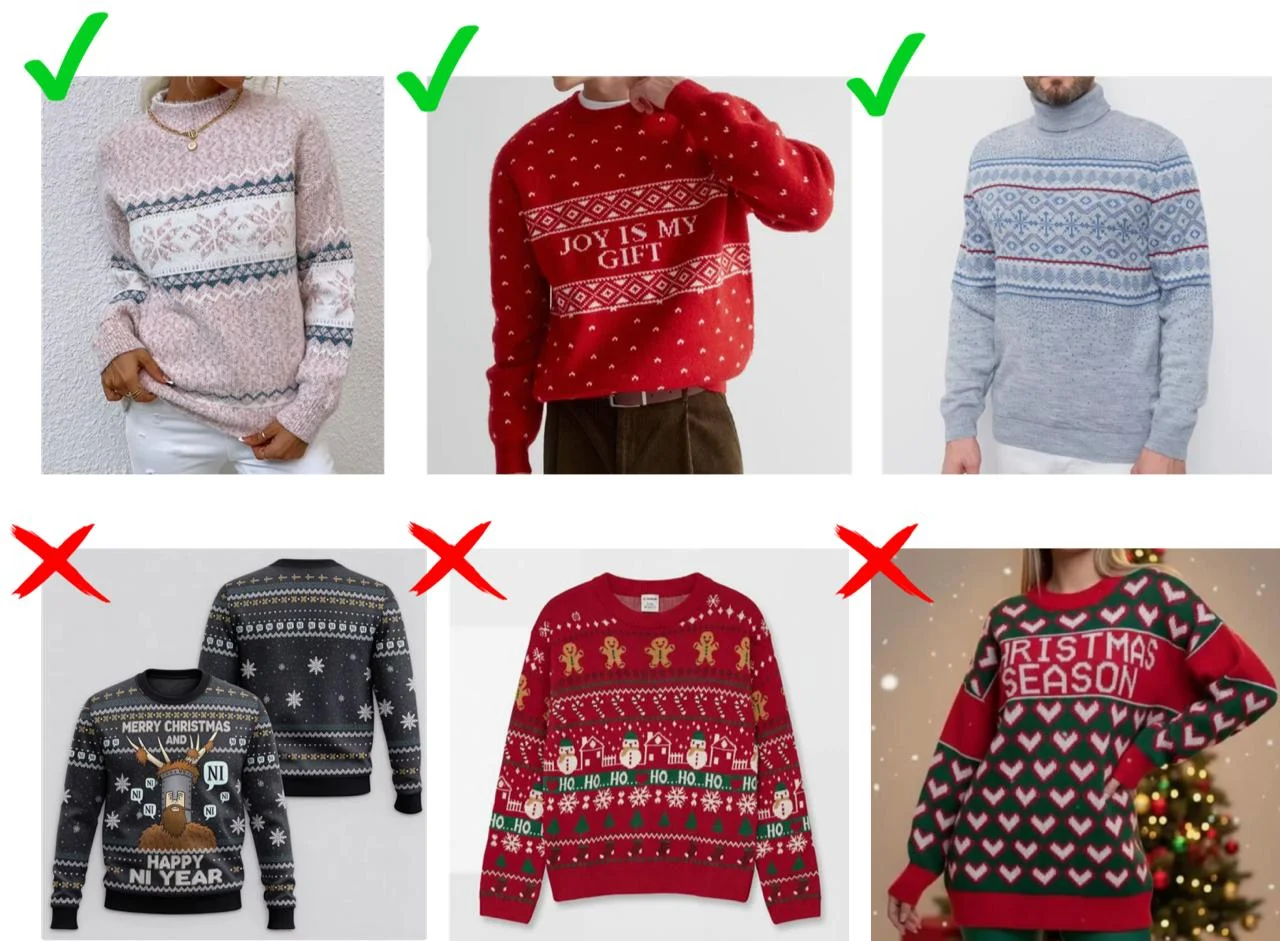
In the upper left of the comparison, the pale pink sweater uses a restrained palette and bands of winter pattern. The light blue turtleneck on the right takes a similar approach. Their decoration can be part of an ordinary winter outfit without needing a specific celebration to explain it.
The red sweater in the upper middle is a more expressive option. Its “Joy Is My Gift” slogan and patterned bands still feel festive, so it is not as neutral as the pink or blue examples. It may work beyond the holiday if bright red and cheerful slogans already belong in your wardrobe. A green check is a starting point for that decision, not a guarantee.
The lower row puts the occasion more clearly in the foreground. The dark design includes explicit Christmas and New Year greetings. The middle sweater combines gingerbread figures, seasonal imagery and repeated “Ho, ho, ho” lettering. The red-and-green design on the right carries a large Christmas slogan. These can be enjoyable festive pieces, but styling them with plain trousers will not remove that message.
Notice that colour alone does not explain the comparison: there is a red sweater in both rows. The stronger distinction is how many holiday cues appear together, how prominent they are, and whether you enjoy wearing those cues outside the event.
Compare four details before deciding
Use this as a quick way to inspect an item, rather than a score that every sweater has to pass.
| Detail | More adaptable for everyday wear | More focused on the occasion |
|---|---|---|
| Words | No text or a message you enjoy all season | A holiday name, greeting or event date |
| Main motif | Geometry, stripes or a motif already in your style | A large festive scene or several holiday icons together |
| Colour combination | Colours that work with your usual layers and bottoms | A combination you only choose for themed events |
| Visual emphasis | A pattern you can comfortably build an outfit around | Several large graphics competing for attention |
No single feature decides everything. A bright piece can be versatile in a colourful wardrobe. A small graphic can still name a very specific event. Consider the design as a whole and the clothes you already own.
Build three outfits with clothes you already have
Before buying, give the piece three realistic places to go. You do not need three completely different wardrobes; small changes in bottoms, shoes and layers can show whether the new item belongs with your existing clothes.
- 1.Make an everyday outfit with your usual jeans or trousers and comfortable shoes.
- 2.Make a slightly smarter outfit for a lunch, dinner or other setting you actually attend, using a skirt or tailored trousers if those suit your style.
- 3.Make a layered outfit with a coat, jacket or cardigan you already wear in that weather.
For example, a pale patterned knit might work with blue jeans and trainers, dark trousers and loafers, or a simple skirt and boots. A red graphic sweater might feel more balanced with plain dark denim and a familiar coat. These are starting points: the useful test is whether your own combinations feel like you.
Keep the supporting pieces relatively simple while you evaluate the graphic. That makes it easier to see whether you like the sweater itself. Once you know it works, you can add more colour or pattern if that is how you normally dress.
If every outfit requires another purchase, pause. The seasonal piece may be asking for a bigger wardrobe change than you intended.
Check the garment as well as the graphic
A versatile pattern cannot rescue a neckline you dislike or sleeves you constantly push out of the way. Compare the shape with a sweater or T-shirt you already wear often. Think about length, volume, how it sits with your preferred bottoms, and whether it will fit comfortably under your usual outer layer.
Read the material description, care label and measurements when they are available. A photograph can show the appearance of a knit, but it cannot tell you reliably how it will feel against your skin, how warm it will be or how easy it will be to care for. If trying it on is an option, use that opportunity to check comfort and movement.
Use a visual preview to compare the overall look
If you are choosing between a subtle seasonal pattern and a more expressive graphic, Fashion Studio AI's virtual try-on can give you another visual reference. Start with a clear image of the garment and a clear photo of yourself. When comparing two options, use the same person photo so the pose and background are not changing at the same time.
Look first at the broad impression: the colour near your face, the amount of pattern and the overall shape. Then return to the original product image to inspect the actual slogan and design. AI-generated previews may alter lettering, small motifs, texture or proportions, so they should not be used to verify those details.
A virtual try-on is a visual preview, not a measurement or a guarantee of fit. Use the product description, size chart and an actual try-on where possible to decide about sizing, comfort and material.
Give occasion pieces an honest place in your wardrobe
Sometimes the loudest holiday graphic is the one you really want. If you enjoy a themed party, have a yearly tradition or simply like that design, an occasion piece can still be a considered choice.
You can wear it for the same celebration in future years, share it with someone when appropriate, or use an item you already own instead of buying a new one each season. The useful distinction is between choosing an occasional piece deliberately and expecting it to become an everyday staple when you know it will not.
Before you decide, check four things: whether you like the graphic without the festive setting, whether it works with clothes you own, whether the garment suits your practical needs, and whether you are comfortable with how often you expect to wear it. That is a more useful standard than treating every green check or red cross as a universal verdict.
Ready to try it yourself?
Explore try-on examples and create outfits with Fashion Studio AI.
Add to ChromeFrequently asked questions
Can I wear a snowflake sweater after Christmas?
Yes, if you like it and it suits the weather and occasion. Snowflakes can read as a winter motif rather than a Christmas message. Look at the rest of the design too: added greetings or festive characters may make the overall sweater feel more specific.
Are red and green always too festive for everyday wear?
No. Either colour can work in an everyday wardrobe. Together they may suggest a festive palette, especially alongside holiday graphics, but the overall design and your personal style matter more than a blanket rule about colour.
Is a general slogan more versatile than a holiday greeting?
It can be, because it does not name a particular celebration. Still, consider the lettering, surrounding motifs and whether you enjoy slogan clothing normally. A general message can remain strongly festive in context.
Can I make a holiday-specific sweater look less themed?
Plain bottoms and familiar layers can make the outfit feel calmer. They will not change an explicit greeting or character on the sweater. If you are happy with that message outside the holiday, you can wear it; if you are not, styling alone may not solve the problem.
Does this idea apply to Halloween graphics too?
Yes. A skull, star or other motif may fit your usual style beyond Halloween, while a design naming the event can feel more occasion-specific. Choose based on what you would genuinely reach for after October, rather than assuming any one motif is automatically versatile.
How many outfits should I be able to make before buying?
Three is a useful practical exercise, not a requirement. The aim is to find believable combinations with clothes you already own. One outfit you will wear regularly may be more useful than several combinations you would never choose in real life.
Will virtual try-on reproduce the exact words and knitted pattern?
Not reliably enough to use as a product check. Generated images can change letters, motifs and fabric texture. Use the preview to compare the broad visual effect, and use the original listing to judge the actual graphic and garment details.
Last checked October 14, 2026 · Fashion Studio AI